
Leave Your Message
Precision-engineered roll forming equipment designed for passive fire containment, HVAC air safety isolation, and structural integrity in high-rise commercial buildings.
 V-Type Steel Formwork Machine for Fire-Rated Floor Slabs in High-Rise Offices
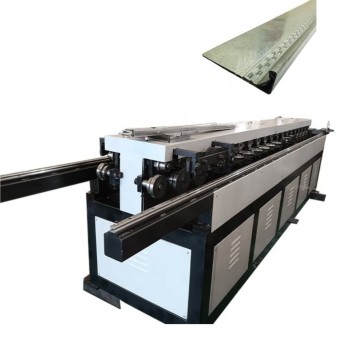 GDF20/30 Flange Roll Forming Machine for HVAC Air Safety Isolation Duct Systems
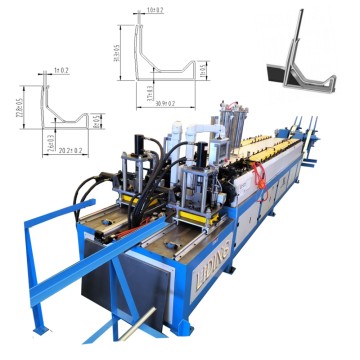 Hydraulic TDC Flange Forming Machine for Passive Fire Containment HVAC Duct Networks
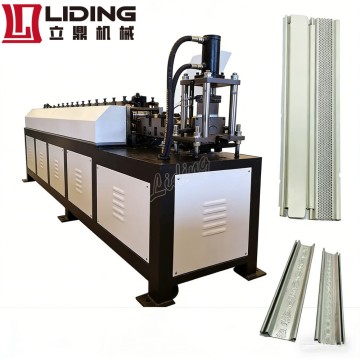 Rolling Shutter Slat Machine for Fire-Rated Compartment Barriers in Commercial Buildings
High-rise commercial office buildings present some of the most demanding engineering challenges in modern construction — not only in structural performance, but critically in passive fire protection and air safety management. The ability to contain fire spread, control smoke migration, and maintain the integrity of HVAC air isolation systems across dozens of floors depends heavily on the precision and quality of the metal components used throughout the building envelope and service cores.
Cold forming machines — or cold roll forming equipment — have emerged as the cornerstone manufacturing technology behind these life-safety systems. Unlike hot-rolled or cast metal components, cold-formed steel profiles offer superior dimensional consistency, higher yield strength-to-weight ratios, and the ability to produce complex cross-sectional geometries that are essential for interlocking fire barrier assemblies, airtight duct flanges, and firewall stud framing.
Cold-formed steel components used in passive fire containment and air safety isolation systems must meet extremely tight dimensional tolerances — typically ±0.1mm — to ensure airtight joints, proper intumescent seal engagement, and consistent fire resistance ratings across large-scale installations.
Passive fire containment refers to the use of structural and architectural elements — rather than active suppression systems — to contain the spread of fire and smoke within predefined compartments. In high-rise commercial offices, this encompasses fire-rated partition walls, fire doors, floor-ceiling assemblies, and crucially, the sealing and isolation of all penetrations through these barriers including HVAC ducts, cable trays, and service risers.
Cold-formed steel studs, tracks, and profiles form the skeletal framework of these fire-rated partitions. The precision of their manufacture directly determines the effectiveness of the fire resistance rating achieved — a 90-minute or 120-minute fire wall is only as reliable as the dimensional accuracy of its component steel profiles.
Beyond structural fire barriers, air safety isolation is equally critical in tall commercial buildings. HVAC ductwork that passes through fire-rated compartments must be sealed with fire dampers, intumescent collars, or equivalent devices — but the effectiveness of these components depends entirely on the dimensional accuracy of the duct flanges and profiles they interface with.
Cold forming machines used to manufacture TDC (Transverse Duct Connection) and TDF flange systems produce the precise angular profiles that create the airtight, mechanically robust connections between duct sections. Any deviation in flange geometry results in air leakage that compromises both energy efficiency and fire safety — potentially allowing smoke to bypass fire-rated dampers and spread through the building's ventilation network.
In high-rise office towers exceeding 100 metres in height, stack effect pressure differentials can drive smoke through even minor duct leakage points at significant velocity — making precision-formed HVAC flanges and air isolation components not merely a quality preference, but a life-safety imperative.
Global demand for high-rise commercial construction continues to accelerate. With over 1,000 new towers above 200 metres under construction or in planning globally as of 2025, and tightening fire safety codes in the EU (EN 1366 series), North America (NFPA 92, UL 555), and Asia-Pacific markets, the requirement for precision cold-formed components in passive fire and air safety applications has never been greater. Manufacturers and contractors alike are investing in advanced cold forming production lines to meet this demand at scale.
From fire-rated partition framing to smoke-proof HVAC duct networks, cold forming technology underpins every critical safety system in modern commercial towers.
Cold roll forming machines produce the light gauge steel studs and tracks used to construct fire-rated partition walls throughout office floors. Profiles are engineered to specific web depths and flange widths to accommodate intumescent strips and fire-resistant board systems, achieving ratings of 30 to 240 minutes as required by local codes. High-speed production lines running at 25–40 metres per minute ensure large-scale projects can be supplied without bottlenecks.
TDC and GDF flange roll forming machines produce the precision longitudinal and transverse flange profiles that connect duct sections passing through fire compartment walls. The flanges must mate perfectly with UL-listed fire dampers and smoke dampers to maintain the integrity of the fire barrier. Hydraulic TDC 2-in-1 machines capable of forming both TDC-20 and TDC-30 profiles provide the flexibility needed for varying duct sizes across different building zones.
Rolling shutter slat forming machines manufacture the interlocking steel slats used in fire-rated rolling shutters that protect large openings — such as loading bays, atriums, and corridor intersections — in commercial towers. The slat profile geometry determines the shutter's fire resistance rating and its ability to remain operable (or to fail-safe to the closed position) under fire conditions. Precision cold forming ensures consistent slat interlock with no gaps that could allow fire or smoke passage.
The hollow damper blade production line manufactures the precision-formed blades used in both volume control dampers (VCDs) and fire/smoke combination dampers. Dual-strip hollow blade technology produces a structurally rigid, lightweight blade that maintains its shape and seating force under high-temperature conditions — critical for fire damper effectiveness. Integrated 4-machine production lines enable turnkey, high-volume manufacture of these safety-critical components.
In seismically active regions, HVAC ductwork and fire protection pipework must be supported on seismic restraint brackets capable of withstanding significant lateral forces without detaching from the structure — which could rupture duct connections and compromise fire damper integrity. Cold roll forming machines produce the C-channel, omega, and strut profiles used in certified seismic bracing systems, with patented profile geometries that optimise load distribution and connection rigidity.
V-type steel formwork produced by dedicated roll forming machines creates the permanent formwork for fire-rated composite floor slabs in high-rise construction. The profile geometry of the formwork deck determines the structural fire resistance of the floor assembly — deeper V-profiles provide greater concrete cover over the steel, extending the fire resistance period. Fully automatic formwork machines ensure consistent profile accuracy across the large volumes of deck required for multi-storey commercial towers.
Market dynamics, regulatory shifts, and technological innovation are reshaping how cold forming machines serve the passive fire and HVAC safety sector.
Regulatory frameworks worldwide are progressively tightening fire safety requirements for high-rise buildings. The EU's Construction Products Regulation (CPR), NFPA standards in North America, and evolving codes across Southeast Asia and the Middle East are mandating higher fire resistance ratings and more rigorous third-party certification of passive fire protection components. This is driving a sharp increase in demand for cold forming machines capable of producing profiles with tighter dimensional tolerances, as non-compliant components are increasingly rejected from projects.
Modern cold forming lines for fire safety components increasingly integrate servo-driven roll sets, CNC-controlled hole punching, and inline laser measurement systems to ensure 100% dimensional conformance without manual inspection. PLC-controlled automatic length cutting and stacking systems reduce labour costs and eliminate manual handling errors that could introduce profile distortions. This automation push is particularly strong in markets where labour costs are rising and project timelines are compressing.
Green building certification systems — LEED, BREEAM, Green Star — are incentivising the use of lighter, higher-strength steel grades in building components, including fire safety systems. Cold forming technology is uniquely suited to processing high-strength steel coils (up to S550 and above) that cannot be readily hot-formed, enabling fire-rated partition and duct support systems to use less material while maintaining or improving structural performance. This material efficiency also reduces transport and installation costs on high-rise projects.
Southeast Asia, the Middle East, and South Asia are experiencing an unprecedented wave of high-rise commercial construction, with new CBD developments in cities from Ho Chi Minh City to Riyadh to Mumbai requiring fully certified passive fire protection and HVAC air safety isolation systems. Local manufacturers in these regions are investing in cold forming production lines to supply these projects, reducing dependency on imported components and shortening supply chains. This trend is expanding the global market for advanced roll forming equipment.
The shift towards off-site prefabrication of building systems — including pre-assembled HVAC duct runs, pre-fabricated fire-rated wall panels, and modular mechanical rooms — is increasing the requirement for cold-formed components that can be produced to tight tolerances in controlled factory environments. Roll forming lines integrated with automated assembly and packaging systems are becoming standard in the supply chains of large prefabrication contractors serving high-rise commercial projects globally.
Leading cold forming machine manufacturers are embedding IoT sensors and data analytics platforms into production lines, enabling real-time monitoring of roll wear, material thickness variation, and production throughput. For fire safety component manufacturers, this capability is increasingly important for demonstrating process control and traceability to third-party certification bodies — a requirement that is growing as building codes demand more rigorous documentation of component manufacturing quality.
Trusted globally for precision cold forming solutions in HVAC, building structures, and passive fire safety applications.
Over 2,000 roll forming machines operating worldwide.
Exporting to Southeast Asia, Middle East, Europe, Russia and beyond.
85% of our clients return for additional production lines.
Average years of experience of our senior engineers.
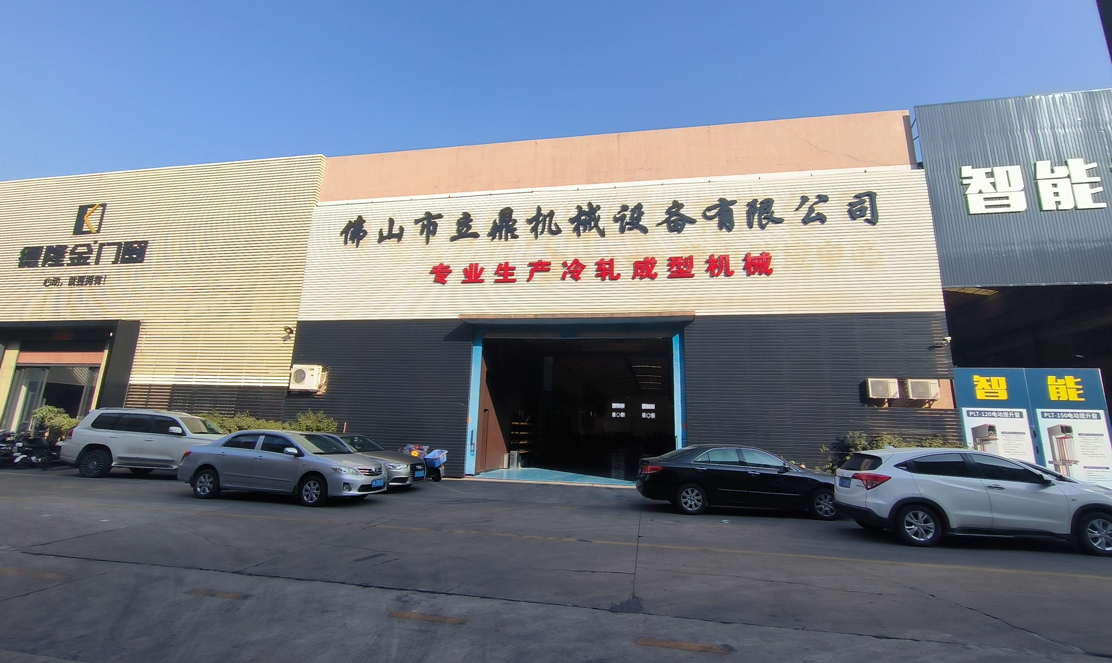
Foshan Liding Machinery Equipment Co., Ltd. was established in 2014, with a core technical team boasting over 25–30 years of experience in the cold-forming industry. We are a specialist manufacturer of metal roll forming equipment, dedicated to providing efficient, precise and reliable customised production line solutions for global HVAC systems, building structures and storage equipment sectors.
We are not merely a machine supplier — we are your strategic partner in product innovation and production efficiency enhancement. We design and manufacture high-precision cold-forming equipment covering HVAC ductwork machinery, building structures (light steel studs, steel formwork, seismic brackets, purlins), and warehouse equipment (racking columns, beams, shelving panels).
What makes Liding Machinery the preferred partner for precision cold forming in passive fire and HVAC air safety applications.
25–30 years of experience in cold bending forming, with a dedicated R&D team of over 10 engineers continuously advancing profile accuracy and machine reliability.
Antiseismic bracket patented technology ensures our forming solutions meet certified seismic restraint requirements for HVAC and fire protection systems in high-rise buildings.
Fully customised on demand — a complete production line solution from initial blueprint through to full-scale mass production, tailored to your specific profile geometry and output requirements.
Global technical support with a guaranteed 48-hour response time. Our after-sales engineering team provides remote diagnostics, spare parts supply, and on-site commissioning worldwide.
Understanding the business forces driving adoption of advanced cold forming technology in the passive fire and air safety sector.
The global pipeline of high-rise commercial office construction represents one of the largest drivers of demand for passive fire containment and HVAC air safety isolation components. According to CTBUH data, the number of buildings exceeding 200 metres completed annually has more than tripled over the past decade, with the Asia-Pacific region — particularly China, Southeast Asia, and India — accounting for the majority of new completions.
Each high-rise tower requires hundreds of kilometres of fire-rated ductwork, thousands of square metres of fire-rated partition wall, and thousands of fire dampers and smoke dampers — all of which depend on precision cold-formed steel components. The scale of this demand is driving investment in high-speed, automated cold forming production lines capable of supplying multiple large projects simultaneously.
Beyond regulatory compliance, the insurance industry is increasingly influencing the specification of passive fire protection and HVAC air safety isolation systems in commercial high-rises. Insurers underwriting large commercial towers are requiring higher standards of component certification, traceability, and installation verification as a condition of coverage. This is pushing developers and main contractors to specify cold-formed components from certified manufacturers with documented quality management systems — elevating the value proposition of established cold forming machinery producers with ISO and CE credentials.
For manufacturers supplying fire-rated partition studs, HVAC duct components, and damper blades, investing in precision cold forming equipment represents a compelling total cost of ownership argument. High-speed lines running at 30–50 metres per minute dramatically reduce the unit cost of produced profiles compared to press braking or manual forming methods — while simultaneously achieving superior dimensional consistency that eliminates costly rework and rejection of non-compliant components on the job site.
When a single fire damper flange fails a leakage test due to a malformed duct connection, the cost of remediation — cutting out installed ductwork, reforming or replacing components, re-testing — can exceed the cost of the entire duct run. Precision roll forming eliminates this risk, making the investment in quality forming equipment directly recoverable in reduced defect rates and project claims.
A significant trend among HVAC and passive fire protection contractors in emerging markets is the localisation of component manufacturing. Rather than importing cold-formed profiles from established manufacturing centres, contractors and distributors in Southeast Asia, the Middle East, and Africa are investing in their own roll forming lines to control lead times, reduce import costs, and capture the value-added margin in component production. Liding Machinery's turnkey production line solutions — delivering complete lines from coil decoiling through forming, punching, cutting, and stacking — are ideally positioned to serve this localisation trend.
Our machines and manufacturing processes are backed by internationally recognised quality certifications.
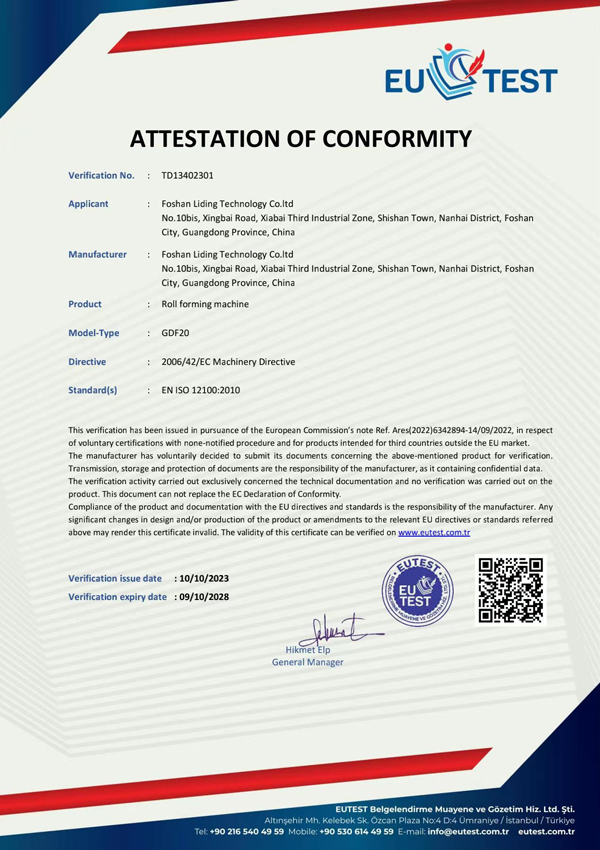

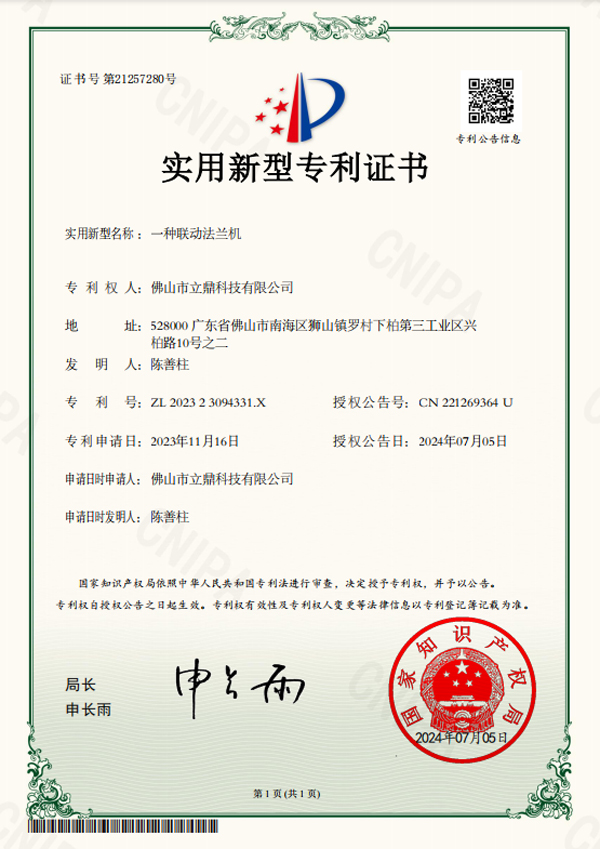
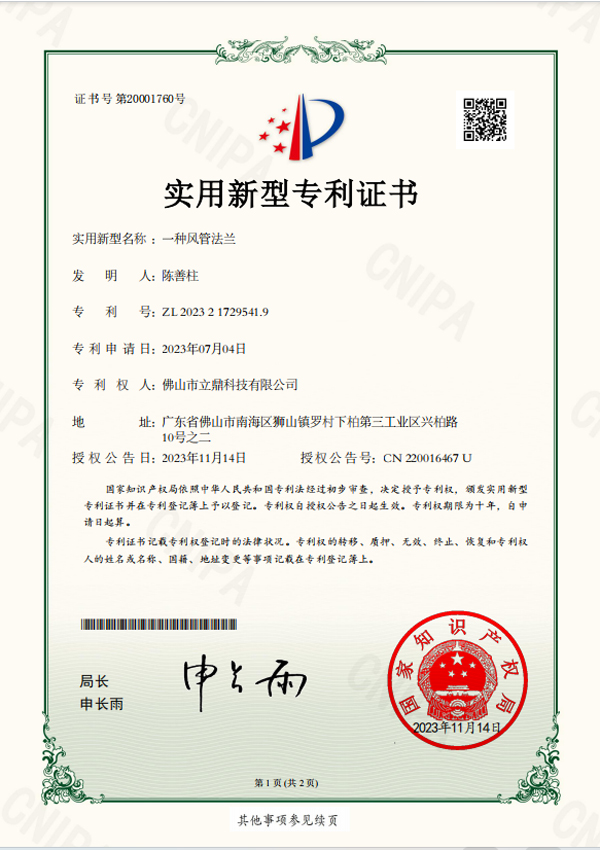
Explore our full range of precision roll forming machines engineered for passive fire containment, HVAC air safety isolation, structural building systems, and industrial storage in high-rise commercial applications.
V-Type Steel Formwork Machine for Fire-Rated Composite Floor Systems in High-Rise Offices
GDF20/30 Flange Roll Forming Machine for HVAC Air Safety Isolation Duct Flange Profiles
Hydraulic TDC Flange Forming Machine 2-in-1 for Passive Fire Containment HVAC Duct Systems
Rolling Shutter Slat Machine for Fire-Rated Compartment Barriers and Smoke Control in Commercial Buildings
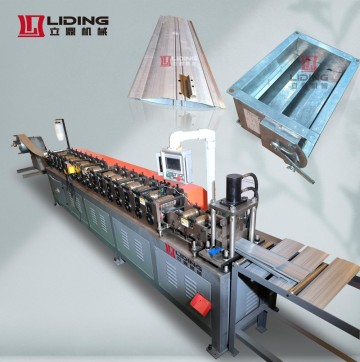 Turnkey Dual-Strip Hollow Damper Blade Production Line for HVAC Fire Damper and VCD Manufacturing
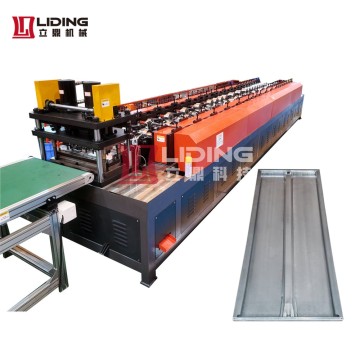 Storage Rack Shelf Box Panel Roll Forming Machine for Fire-Safe Commercial Building Infrastructure
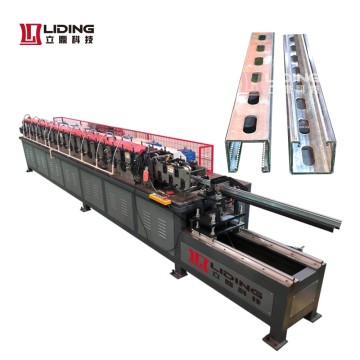 Changeable Solar C Channel Machine for Seismic-Rated HVAC Support Structures in High-Rise Buildings
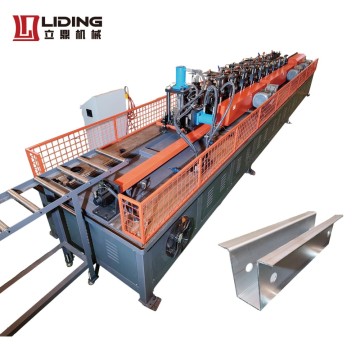 Changeable Omega Bracket Roll Forming Machine for Fire Protection and HVAC Restraint Systems